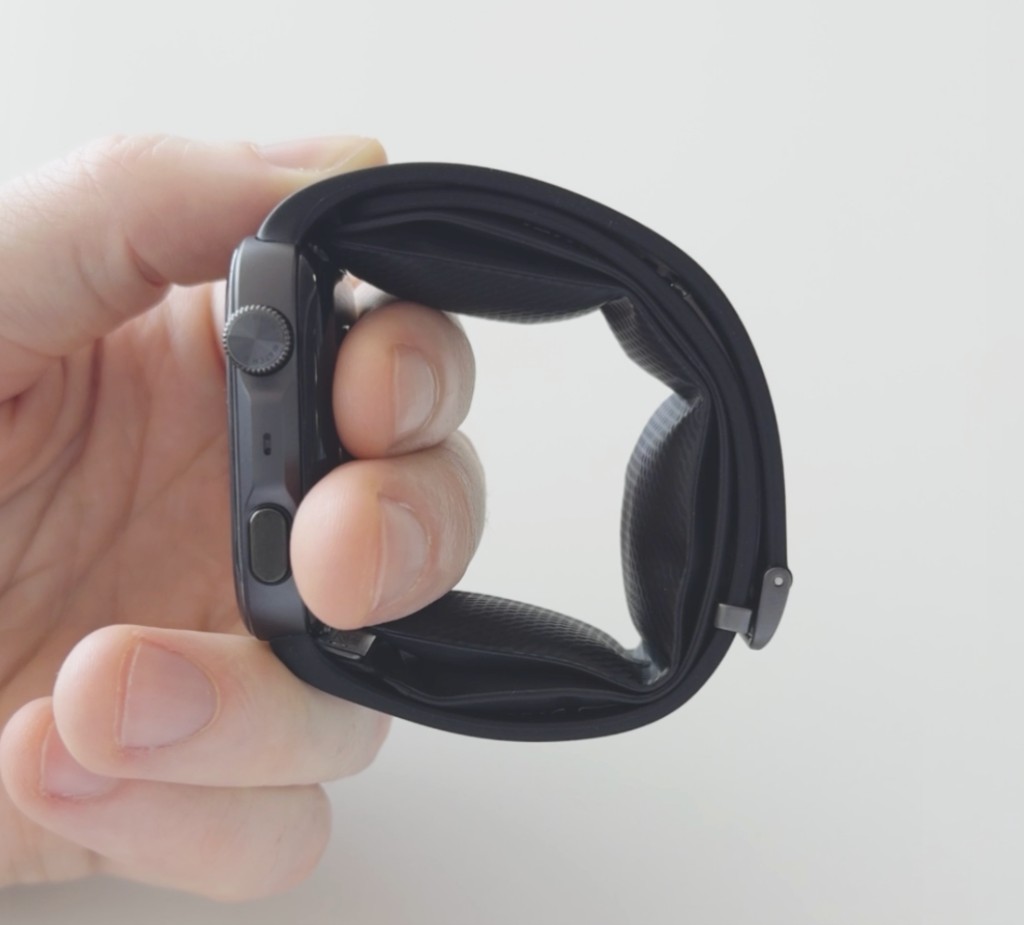
The Huawei Watch D3 is the 2026 version of Huawei's blood pressure watch: a 11.3 mm case with a mechanical airbag in the strap, systolic and diastolic readings, and a 24-hour monitoring plan you can hand to a GP. It is not the Band 10 or Band 11, which cannot measure blood pressure at all. It is also not a US product yet, and the early independent checks do not all agree with an upper-arm cuff.
Disclosure: Fitcoin is our product. We are not affiliated with Whoop, Oura, Google, Fitbit, Garmin, Polar, Amazfit, Xiaomi, Samsung, Ultrahuman, RingConn, Hume Health, Bionny, Apple or any other hardware brand named here. We do not sell trackers and we take no affiliate commission. Where Fitcoin appears, it is as the rewards and insights app that reads the data these devices write to Apple Health or Health Connect. Everything below is a wellness estimate for general fitness, not medical advice.
The verdict
Buy the Huawei Watch D3 if you want systolic and diastolic numbers from a wrist cuff, you live where it is actually sold, and you will still check it against a validated upper-arm monitor before you trust the offset. Skip it if you wanted a Huawei Band, a swim watch, a Whoop-style coach, or a US retail product. The Band 10 and Band 11 do not measure blood pressure. This watch does, because the strap inflates.
Which Huawei this is
Search for a Huawei band that measures blood pressure and you land on the wrong product page almost every time. The Band 10 and the Band 11 track heart rate, SpO2 and HRV. They do not have a pressure sensor, and Huawei Health will only store a blood pressure number on those bands if you type one in from a separate monitor. The device that measures it is the Watch D3, the third watch in a line that started with the Watch D in 2021 and added 24-hour ambulatory monitoring on the Watch D2 in 2024.
Huawei showed the D3 at the European Society of Cardiology congress in Munich in September 2026, then put a UK product page up and a price on it. At publication it is £399.99 on Huawei's UK store, in Black, Gold and Mocha Gold. European pricing sits around €449. Huawei Denmark listed it at 3,799 DKK with sales from 12 October 2026. There is no official US launch and no US price. Importing one does not create FDA clearance.
The reason it can quote millimetres of mercury, when an Apple Watch and a Whoop cannot, is mechanical. A narrow airbag in the strap inflates around the wrist. A pressure sensor reads the oscillations. That is the same oscillometric method an upper-arm cuff uses, moved to a smaller artery and a fussier posture. If you only wanted a trend line, the cheaper conversation is the Hume Band 2.0 or Whoop MG, and neither of those is a cuff.
What you are buying
| Huawei Watch D3 | |
|---|---|
| Price at publication | £399.99 in the UK. About €449 in Europe. No official US price. |
| Blood pressure | Oscillometric wrist cuff. Spot checks, 24-hour ABPM, and pre- and post-exercise checks on run, walk and cycle. |
| Certification | CE-MDR as a medical device in the EU, for those blood pressure measurements. Not a diagnosis, and not an FDA-cleared US product. |
| Case and screen | 11.3 mm thick. 1.92-inch AMOLED, 3,000 nits peak. Narrower airbag and a lighter strap than the D2. |
| Battery | Up to 6 days in Huawei's typical-use test. About 1 day with ambulatory monitoring at 15-minute intervals. |
| Wrist size | M strap 13.0 to 16.0 cm. L strap 16.1 to 21.0 cm. Outside that, Huawei says accuracy can slip. |
| Phones | Huawei Health on Android 9 or iOS 13 and later. Not a Wear OS watch and not an Apple Watch companion. |
| Water | Take it off to swim, shower or sit in a sauna. Dry it before a blood pressure check. |
How a reading actually works
A spot check is a seated measurement, not a glance. Huawei's own posture card is long because wrist cuffs fail when you improvise. Sit with your back supported, feet flat and uncrossed, wrist at heart height, palm open, elbow supported, and do not press the airbag. Stay quiet. Do not talk. Reviewers put a single inflation at roughly 40 seconds to under a minute, which matches a home monitor more than a tap-to-measure wellness tile.
Ambulatory monitoring is the feature clinics already recognise. European Society of Hypertension practice guidance, which Huawei cites on the product page, asks for measurements every 15 to 30 minutes across 24 hours, with at least 70 percent of them successful, including 20 by day and 7 at night. The D3 can run that plan. During the day you still have to stop and hold the posture. At night the airbag inflates on its own while you sleep, which is the point of an overnight trace and also the reason the strap will never feel like a Whoop. Huawei then builds a report in Huawei Health with daytime, night-time and 24-hour averages you can take to a GP.
New on the D3, and inside the CE-MDR scope Huawei described at the cardiology congress, are pre- and post-exercise checks for outdoor and indoor running, walking and cycling. The watch can tell you to hold off if pressure is high before the session, then ask for a reading within two minutes after. There are also reminders when temperature drops suddenly or you gain altitude. Those are prompts to measure, not a judgement that you are safe to train.
How accurate is the cuff?
Certification and agreement with a cuff you already trust are different questions. CE-MDR means the D3 passed the regulatory file for the measurements Huawei claimed: single readings, ambulatory monitoring, and pre- and post-exercise readings. It does not mean every wrist will match every upper-arm monitor in a kitchen.
Independent wear is thin, and it does not agree with itself. T3 compared the D3 with a Garmin Index BPM upper-arm monitor across three sessions and saw the Huawei run lower: about 16 mmHg on systolic and about 5 mmHg on diastolic, on average. That is a large, repeatable offset for the feature you bought the watch to get, and T3 said so. Stuff compared it with a relative's home cuff and called the match remarkably close. Neither write-up is a clinical trial. We have not worn a D3 against a reference monitor, so this review does not pretend to settle the gap.
What you should do, if you buy one, is boring and worth it. For a week, take a D3 reading and a validated upper-arm reading in the same posture, a minute apart, morning and evening. Write both down. If the offset is stable, you and your clinician can read the watch as a trend around that offset. If the offset jumps around, the watch is a prompt to use the upper-arm cuff, not a replacement for it. Huawei also tells you to talk to a doctor first if you have an arrhythmia, arteriosclerosis, poor perfusion, diabetes or kidney disease, because those can move a wrist reading further from an arm reading.
Wrist size is a hard limit, not a comfort note. Under 13 cm or over 21 cm, Huawei says accuracy may be affected. Pick the M or L airbag for the wrist you will actually measure on. A watch that fits as jewellery can still be the wrong cuff.
Battery, wear and the rest of the watch
Huawei's typical-use test quotes up to 6 days: heart rate always on, TruSleep at night, stress and SpO2 on, six blood pressure checks and five ECG traces a day, a modest amount of calls, music and exercise, and the screen on for 30 minutes a day. Turn on ambulatory monitoring at 15-minute intervals and the same lab test falls to about 1 day. That is fine for a planned 24-hour study. It is a bad default. The product page pairs the 6-day claim with a 75-minute charge. T3 saw a charge from 8 percent to full in under 55 minutes, then 34 percent left after six days of ordinary use, so the everyday number is in a plausible range. The ABPM number is the one to plan around.
The case is 11.3 mm thick, down from 13.3 mm on the D2, and Huawei says the strap is 7.5 g lighter, with about 9 percent less weight and 15 percent less thickness overall. The airbag is narrower. It is still an airbag. You will notice it when it inflates, and you should take the watch off if the strap fails to deflate. Prolonged wear can irritate skin. Huawei says bruising is possible if you measure too often.
The 1.92-inch AMOLED is quoted at 3,000 nits peak under an 80 percent average picture level, which is a lab stimulus, not a promise that maps will look that bright. Bluetooth calling, a calendar, a torch and NFC payments through Curve Pay are there in markets where those features ship. Curve Pay is not Apple Pay and not Google Wallet. Workout modes are listed at 100-plus, with some arriving in a software update, including a shorter session mode. This is not the watch we would buy for mapped intervals. Huawei leads with blood pressure, sleep and a bright screen. If the route is the product, buy a running watch.
Water is the practical catch. If the watch is wet from rain or hand washing, dry it before a blood pressure measurement, or Huawei says the airbag can misbehave. Take it off for swimming, snorkelling, showers, hot tubs and saunas. Household chemicals, sunscreen and sanitiser are on the avoid list. Liquid damage from those situations is not covered. A fitness band you can forget in the pool, this is not.
ECG, sleep and the wellness layer
Beside the cuff, the D3 has the usual Huawei health stack, and Huawei is careful about which parts are medical. Pulse-wave arrhythmia analysis uses the optical sensor for AFib prompts. The ECG app asks you to hold the side electrode for about 30 seconds. Both are market-dependent and, in Huawei's footnotes, not a basis for diagnosis or treatment. Do not assume a UK ECG feature is switched on in every country the watch is sold.
TruSleep 5.0 stages the night and talks about sleep stability. Health Glance is a short report of about 11 items, including HRV, in certain markets, and Huawei labels it as not for medical use. Emotional wellbeing names up to 12 moods and does not run during sleep or exercise. A Physical Readiness score and the family health-sharing view are listed as software updates, not as features you can assume are on the watch the day it arrives. Buyers also get a three-month Huawei Health+ trial: workouts, meditations, sleep audio. That is a voucher, not a reason to spend £399.99.
If the morning number you actually want is recovery rather than blood pressure, you are in a different shop. Whoop 5.0, Garmin CIRQA and Fitbit Air are built for that question, and none of them inflates a cuff. HRV, which all of them report in their own units, is explained in what a good HRV looks like.
Where the numbers live
Blood pressure, the ABPM report and the ECG stay in Huawei Health. The D3 pairs with iPhone and Android through that app. It does not run watchOS or Wear OS, so Apple's blood pressure log and Samsung's health app are not the home for these readings. Family sharing of blood pressure is described as an update inside Huawei's own community feature.
Fitcoin does not import those cuff readings. Fitcoin scores workouts and steps that already sit in Apple Health or Health Connect, then adds rewards plus Sleep, Recovery and Energy views. If your runs and walks also land in one of those stores, from a phone or from another watch, Fitcoin can use that activity. It cannot see a D3 blood pressure trace, and it should not be asked to.
Who should buy it
- Buy it if a clinician has asked you to capture more than one office reading, you will run a proper 24-hour plan occasionally, and you would rather wear the cuff than unpack a monitor. You also need a wrist inside 13 to 21 cm and a country where the watch is sold.
- Buy an upper-arm monitor instead if you need a number your doctor already trusts, you are pregnant, your wrist is outside the strap range, or you will not sit still for the posture. A £40 validated cuff beats a £400 watch you measure badly.
- Buy a normal trainer if blood pressure was a nice-to-have on a running watch. The D3's exercise checks cover run, walk and cycle, then the strap has to come off for the pool. Whoop, Garmin and Apple Watch are better daily training tools.
- Do not buy a Band 10 or Band 11 for this job. They are good cheap fitness bands. They are not blood pressure devices. Huawei's separate screen-free band, covered in our note on the Huawei screen-free band survey, is still a questionnaire, not a cuff.
How to decide in one sitting
- Confirm the watch is sold and the blood pressure features are enabled in your country. A grey import is a gadget, not a regulated monitor.
- Measure your wrist. If you are outside 13 to 21 cm, stop.
- Ask the clinician who would read the report whether a wrist ABPM file is useful to them. Some want an upper-arm ambulatory monitor and will ignore a watch.
- Plan to calibrate your expectations against an upper-arm cuff for a week. If you will not do that, you will over-read the first odd number.
- If the answer to any of those is no, spend the money on a validated home monitor and a cheaper fitness band.
Frequently asked questions
Does the Huawei Band 10 or Band 11 measure blood pressure?
No. Those bands track heart rate, oxygen and HRV. Blood pressure on a Huawei wrist device means the Watch D series, and the current model is the Watch D3, which uses an inflatable strap.
Is the Huawei Watch D3 a medical device?
In the EU it is CE-MDR certified for single blood pressure readings, 24-hour ambulatory monitoring, and pre- and post-exercise readings. Huawei still says the data is not a basis for diagnosing or treating yourself, and there is no official US launch.
How long does the battery last?
Huawei quotes up to 6 days in a typical-use lab test, and about 1 day when 24-hour ambulatory monitoring is running at 15-minute intervals.
Can I swim with the Watch D3?
Huawei says to take it off for swimming, showers, saunas and other prolonged water exposure, and to dry it before a blood pressure measurement.
Does it work with an iPhone?
Yes. Huawei Health supports Android 9 and iOS 13 or later. It is not an Apple Watch and it does not write its cuff readings into Apple's blood pressure log.
Should I change my medication if a reading looks high?
No. Huawei's warning is explicit: do not diagnose, treat, or adjust medicines from the watch. Talk to your doctor.
Method: Checked September 28, 2026 against manufacturer product pages, published help documentation and independent reviews. Prices are US list at publication unless noted. Fitcoin has no commercial relationship with the hardware brands named here. Wellness estimates only, not medical advice.
Related reading: Watch D3 vs Whoop MG, Watch D3 vs Apple Watch, Whoop MG review, Hume Band 2.0 review, Huawei screen-free band, What is a good HRV?
About the author: Harris Khan is the co-founder and CTO of Fitcoin, a UK fitness-rewards and health-insights app that reads Apple Health and Health Connect.