Apple Watch does not have Body Battery. Garmin’s 0–100 energy score is a Firstbeat model on Garmin watches. It is not hiding in watchOS, and you cannot bolt the real thing onto an Apple Watch with a setting. What you can do is pick a Watch app that behaves like a battery: high after sleep, lower after a hard session, instead of staring at Activity rings and guessing.
This page covers that gap. If you want Apple’s night score, see the sleep score explainer. If you want Whoop’s morning colour, see Whoop Recovery explained. This is not a shopping guide for Garmin hardware. If you already own a Garmin, Connect already shows Body Battery. If you already own an Apple Watch and would rather not wear two devices, keep reading.
Short verdict: Stay on Apple Watch if you like the rest of the Apple stack. You will not get Garmin’s exact number. Use a depletion-style Energy or strain score from Apple Health, and treat a single day’s reading as a nudge, not a lab result.
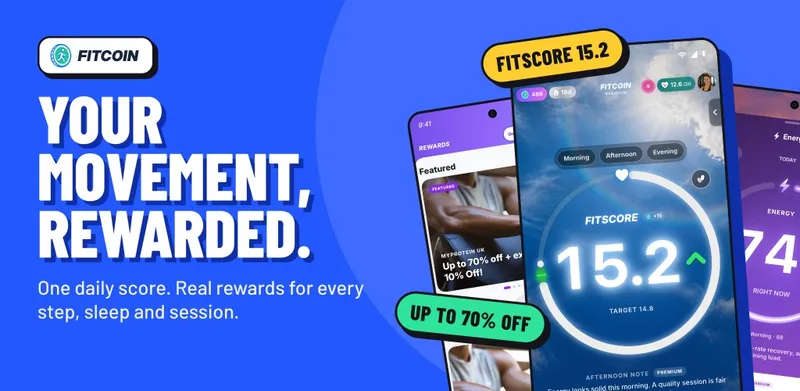
Disclosure: Fitcoin is our product. We are not affiliated with Apple, Garmin, Whoop, Bevel, Athlytic, HRV4Training or the other apps named here. Where Fitcoin appears, it is as a Sleep, Recovery and Energy companion that also scores workouts for partner rewards, not a PayPal cash-out app. Scores described below are wellness estimates for general fitness. They are not medical devices and they do not diagnose illness.
What Garmin Body Battery actually is
Body Battery is a 0–100 estimate of remaining energy. Sleep and quiet rest charge it. Physical activity and stress drain it. Garmin documents it as a Firstbeat Analytics feature that uses heart-rate variability, stress and activity. A 90 at 7am after a long sleep is the point of the score. A 20 at 9pm after intervals and a late meeting is also the point.
The useful behaviour is the shape of the day, not the integer. If the line never falls on a training day, the model is ignoring work. If it never rises after sleep, overnight data is missing. That is the test any Apple Watch substitute has to pass.
Why Apple never shipped a battery
Apple’s Health app already stores the raw ingredients: sleep, heart rate, HRV (as SDNN samples), active energy, workouts. watchOS 26 added a native Sleep Score built from duration, bedtime consistency and interruptions. None of that is a running energy tank.
Apple’s design habit is to show the measurement (hours slept, beats per minute) and let you interpret it. Garmin’s habit is to collapse those measurements into a coaching number. Third-party Watch apps exist because a lot of people want the second habit without leaving Apple hardware.
What actually fills the gap on Apple Watch
| If you want… | Closer Watch-side option | What it is not |
|---|---|---|
| A tank that starts full after sleep and falls through the day | Fitcoin Energy (our product): capacity from sleep history and autonomic baselines, then drains from workouts, time awake and long sitting | Garmin Body Battery. Different maths, same job. |
| A bank that carries leftover energy into tomorrow | Bevel Energy Bank: recovery, sleep, strain and stress, cumulative | A same-day battery. It is a rolling account. |
| How hard today has been, live on the wrist | Athlytic Exertion (0–10) with a target zone from morning Recovery | Overnight charge. Exertion is the drain side only. |
| Whoop’s morning colour without a strap | Recovery apps without Whoop: Bevel, Athlytic, Fitcoin Recovery | Energy. Recovery is whether you can push, not how much is left at 4pm. |
| The real Garmin number | Wear a Garmin | An Apple Watch complication |
Recovery and Energy are easy to mash together. Recovery is a morning or overnight snapshot of how ready the autonomic system looks. Energy is whether that readiness is still in the tank at 5pm. Garmin Body Battery is closer to Energy. Whoop’s green, yellow and red is closer to Recovery. If an app only gives you one number at breakfast, it has not replaced Body Battery.
How Fitcoin Energy is built (and where it stops)
Fitcoin Energy is a depletion model, not a weighted average that barely moves after you train. Overnight sleep history, optional HRV and resting heart rate versus a personal baseline (typically a week of prior days), and residual training load set a morning capacity. Workouts, time spent awake and long sedentary stretches then subtract. By the next morning those acute drains decay, which is why a hard Tuesday should not permanently flatten Wednesday if you slept.
Two catches matter in practice. First, Energy will not invent a number from zero physiology. If sleep and heart data have not synced, you wait. Second, if Immune Shield (overnight breathing rate and wrist temperature versus your own 14-day baseline) drops under 50, Energy is hard-capped at 45. That cap is a wellness circuit breaker, not a diagnosis. Details sit on the wrist temperature page.
Energy is 0–100. It is not FitScore, which is daily activity scored 0–20. Mixing them is how people think a rest day broke the app.
The sedentary trap
A battery that only subtracts workouts will congratulate a 12-hour sit. Garmin users already know this: low stress plus no training leaves Body Battery high, which feels like a lie if you are exhausted from screens. Prefer a model that docks sitting, or ignore the energy number on desk days and look at sleep and Recovery instead. A high energy score and a terrible night are not a green light. They usually mean a missing input.
Who should chase this on Apple Watch
Yes if you already sleep in an Apple Watch, you miss the Garmin graph from a previous watch, and you will actually back off when the tank is empty.
Less useful if you needed Garmin’s Firstbeat number specifically, you will not wear the Watch overnight (then there is nothing to charge), or you only wanted a sleep stage chart. For stages, see Apple Watch sleep stages and the sleep tracking apps list, not energy.
What a Body Battery-style day should look like
After a full Watch-on night, the morning tank should be clearly higher than last night’s evening reading. After a hard session at midday, it should have moved down, not sat at 92 because the app only scores sleep. In the evening, a desk day should not look identical to a session day. If those three checkpoints fail, you do not have a battery model. You have a morning recovery number wearing a battery costume.
Garmin users already use that shape as a conversation with themselves: I have 35 left, so I am not starting a threshold run at 8pm. The Apple Watch substitute has to survive the same sentence. Fitcoin Energy is built for it. Bevel Energy Bank is a multi-day ledger, which answers a slightly different question: have I been overdrawn all week? A morning green or yellow ‘can I train?’ number is a different metric again. If you want that, see Apple Watch readiness score.
Should you wear Garmin and Apple together?
Only if you already do for GPS or cycling sensors. Buying a second watch solely to import Body Battery into an Apple life usually means charging two devices and trusting neither number. Pick a platform. If Apple wins for phone, messages and the Watch you will actually sleep in, stay there and use an Energy app. If Body Battery is the feature you open every morning and you already own a Garmin, keep Garmin as the training watch and let Apple be the phone.
Do not try to make the two integers match. Firstbeat on Garmin and a Health-fed Watch app are different instruments. Trends inside one device are the only honest comparison.
Frequently asked questions
Does Apple Watch have Body Battery?
No. Body Battery is Garmin’s trademarked 0–100 energy score. Apple Watch does not include it in watchOS 26. You get rings, heart rate, HRV samples, sleep and (on newer watches) a Sleep Score, not a battery that charges overnight and drains through the day.
Can I get Garmin Body Battery on Apple Watch?
Not natively, and not as a Garmin Connect Watch complication that copies the Firstbeat model. Third-party Apple Watch apps build their own energy or strain scores from Apple Health. They will not match a Garmin watch number-for-number.
What is the closest Apple Watch alternative to Body Battery?
Look for an app that starts high after sleep and falls as you train and stay awake, rather than a static morning recovery percentage. Fitcoin Energy is built as a depletion model. Bevel’s Energy Bank is cumulative across days. Athlytic’s Exertion is a 0–10 load score, which is the drain side without the charge side.
Why is my energy high if I barely moved?
A battery model that only subtracts workouts will look ‘full’ on a desk day. That can be honest (you did not drain much) and still useless if you wanted a nudge to move. Prefer a score that also docks long sedentary stretches, or ignore energy and look at steps and workouts.
Is Body Battery a medical reading?
No. Garmin’s score and the Watch-app copies are wellness estimates. They do not diagnose fatigue disorders, overtraining syndrome or illness.
Method and sources: Written 13 August 2026 from Apple’s Sleep Score user guide (watchOS 26 / iOS 26.2 bands), Bevel help articles on Key Terms and Common Questions, Whoop’s published Recovery explainer (green / yellow / red bands), Athlytic’s public Recovery and Exertion documentation, Marco Altini’s HRV4Training guidance on morning protocols versus overnight Watch samples, Garmin’s Body Battery description, and Fitcoin’s on-device SleepScore, Recovery, Energy and Immune Shield calculators. Third-party weights, prices and Watch compatibility change. Confirm the live app. Fitcoin inclusion is ownership-disclosed. Wellness estimates only; not medical advice.
Related reading: sleep score apps, readiness on an older Apple Watch, Apple Watch readiness score, Apple Watch Series 12 Readiness score.
About the author: Harris Khan is the co-founder of Fitcoin. He studied at Loughborough University and has more than 15 years of personal experience across strength training, bodybuilding, Muay Thai and general fitness.